Friday, January 29, 2016
Recent notes
Arrhenius reminds me of diarrhea. Just saying. So the first thing we went over this week was the difference between Arrhenius and Bronstead-lowry acids and bases. Arrhenius acids/bases are all the ones we have been using so far. Bronstead-lowry ones have generally not been used by us and have much more specific uses in a Bronstead-lowry equation. The general definition of the acids is that they donate an electron and the bases receive an electron. Our class also learned how to do ice box equations. Which generically evolve into X squared divided by the molarity minus X set equal to Ka. These equations are used to find the ph of weak acids. The last thing we went over is the H+ to OH- to pH to pOH square. this square tells how you can get any htree things from the square when you only start with one.

Tuesday, January 26, 2016
Vitamin C lab
So first off i have to apologize to all the groups because of the fact that Gannon ruined everything. He was only supposed to use one tablet of vitamin c concentration but he used two. Besides that the lab seemed to go off without a hitch. We started the lab by getting samples of 5 different liquids with varying vitamin C concentration. Putting 20 drops of each liquid in a test tube with starch readied them for testing. The testing was conducted by dropping iodine concentration into the test tubes and counting the amount of drops it took to turn fully blue. Then doing some plug and chug equations we were able to find the vitamin c concentration.
Friday, January 15, 2016
Murder mystery lab
There was a murder... DUN DUN DUNUNUNUNN!!!!!!! Of a fictional character who died by mysterious circumstances and all that was left was a puddle of a liquid she drank which caused her to die. to find out who did it we (as the detective) must use our chemistry knowledge to figure out who the culprit was by finding the chemical weapon and the morality of it. To do this we start by mixing the murder weapon with another chemical and because it reacts and forms a precipitate we know it is Silver Nitrate. to find the molarity of the substance we measure the weight of the formed precipitate.
After doing this we narrow down the culprit to being the professor who killed the girl.
After doing this we narrow down the culprit to being the professor who killed the girl.
Acid solutions
Our most recent lesson is about How stoichiometry can be used to find different components in an aqueous solution with an acid
Friday, January 8, 2016
dilutions lab
today we did a lab to give us an example of dilutions and how to do dilutions. We started out with a cup of 20 drops of food coloring . after this was done we proceeded to take one ml out and add 19 ml of clear water so that the next dilution in the line was also 20 ml continuing until the final solution was what looked to be clear water again.
Monday, December 14, 2015
The nail in a jar lab
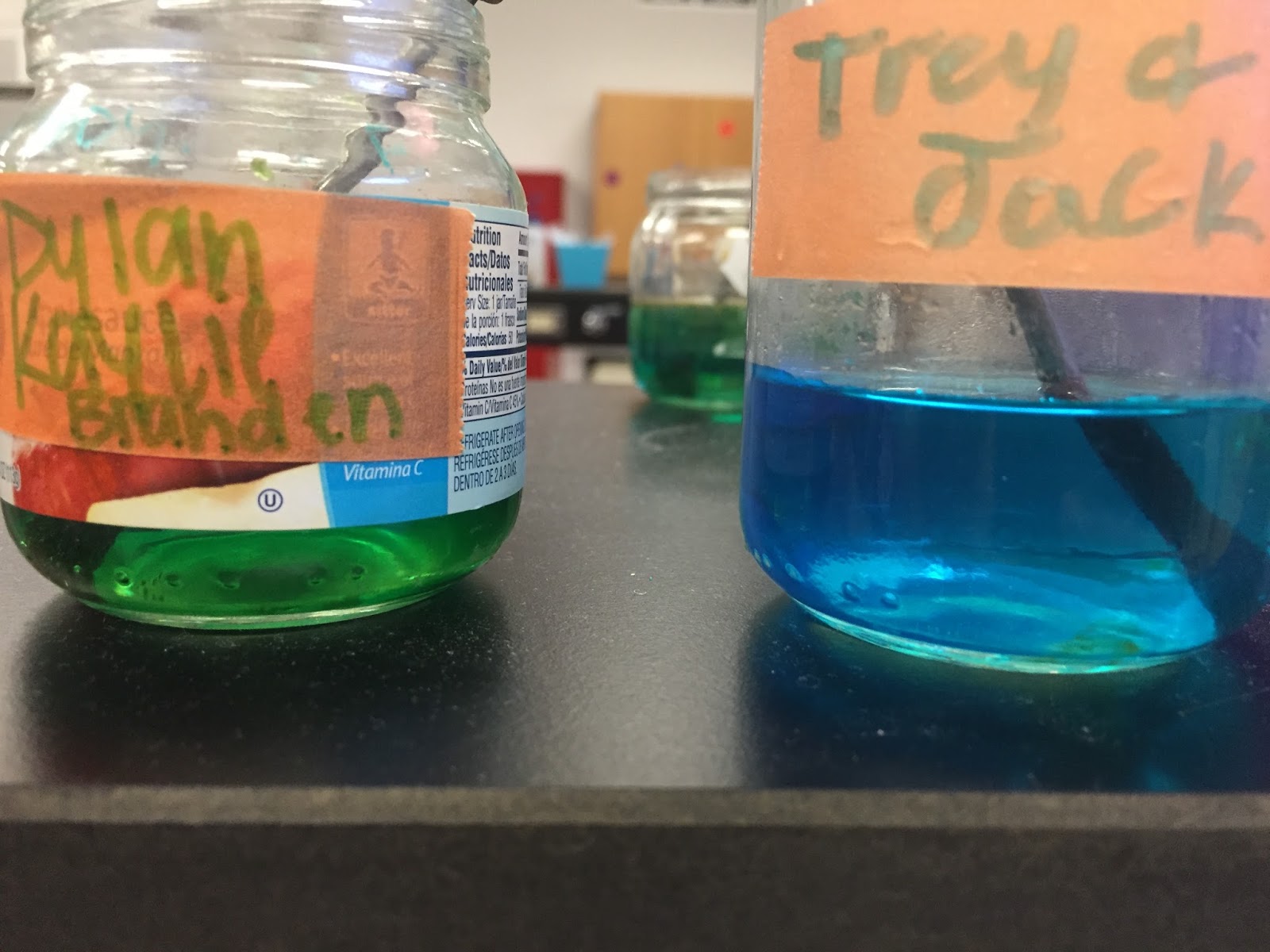
The lab we did over the past 3 days has been to find the product of a reaction of iron and copper chloride. To start this we had to mass a baby food jar, acquire around 4g of copper chloride (put it into the baby food jar with water to mix it), and put a iron nail in the jar. after letting this sit for one day we took out the nail and washed out the jar while leaving the produced copper inside of the jar. After letting this sit for the weekend we to the dried pure copper and got the mass of it and the nail. Using the mass of the nail we found out if the reaction made iron(II) chloride or iron(III) chloride. Most of the reactions made iron(III) chloride.




Friday, December 11, 2015
More Stoichiometry
Its still fun to say. Besides that though we can also use stoic. to tell which reactant (if there is multiple) is the limiting factor and which one will have excess in the equation. This will help us get the proper yield and understand how the reaction works. The limiting factor wil only be needed to be found if the problem gives you more than one reactants mass. If the equation gives 2 or more masses then you must do the standard Stoic. equation on both reactants to find the same product. Whichever reactant yields the least amount of product is the limiting factor and gives the theoretical yield. This forces the other reactant to be the excess. To find the amount of excess used in the reaction you must take the proven theoretical yield and find the mass used of the excess by using the standard stoic. equation on the product.
Subscribe to:
Posts (Atom)