Friday, January 8, 2016
dilutions lab
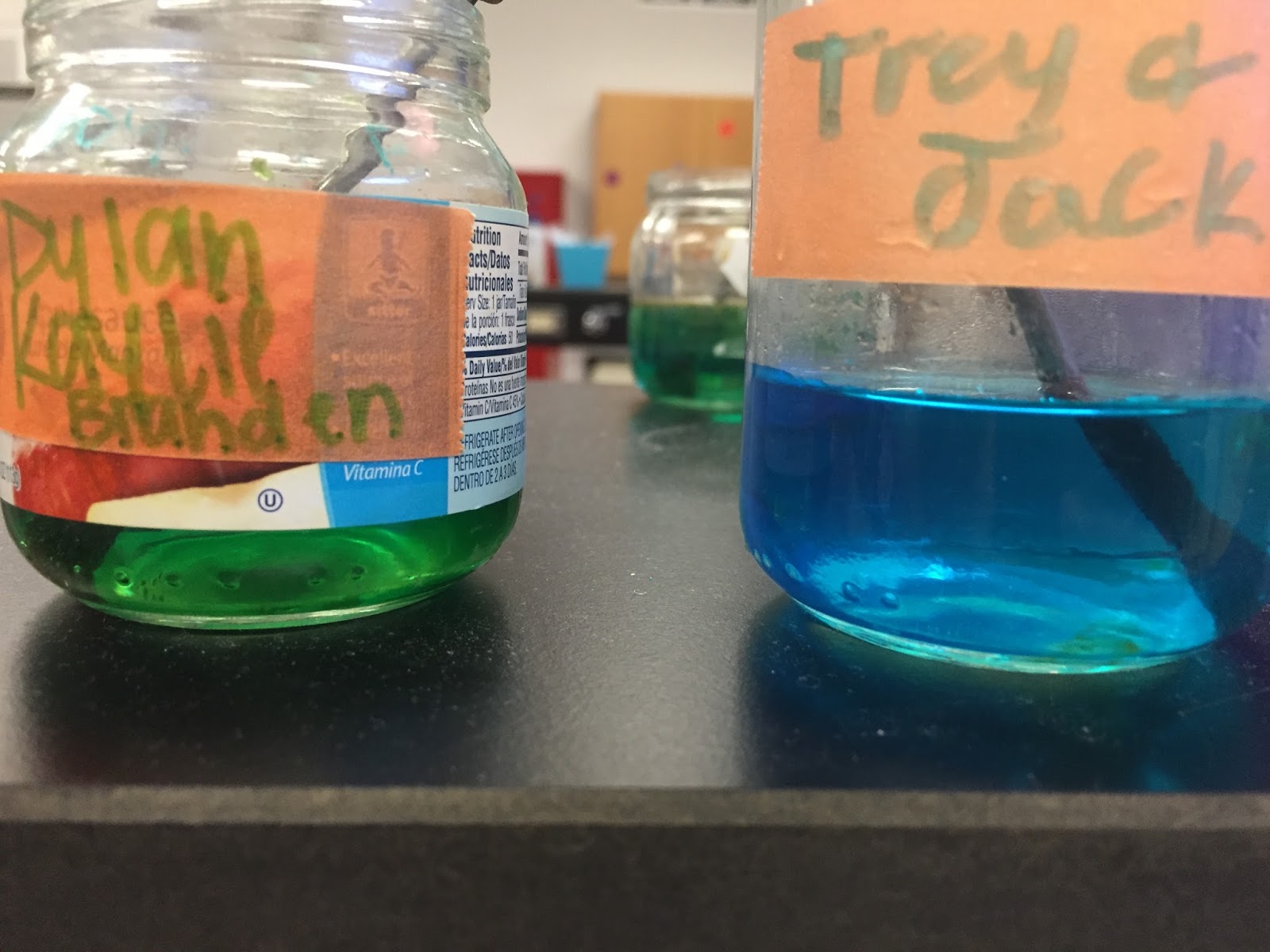
today we did a lab to give us an example of dilutions and how to do dilutions. We started out with a cup of 20 drops of food coloring . after this was done we proceeded to take one ml out and add 19 ml of clear water so that the next dilution in the line was also 20 ml continuing until the final solution was what looked to be clear water again.

Monday, December 14, 2015
The nail in a jar lab
The lab we did over the past 3 days has been to find the product of a reaction of iron and copper chloride. To start this we had to mass a baby food jar, acquire around 4g of copper chloride (put it into the baby food jar with water to mix it), and put a iron nail in the jar. after letting this sit for one day we took out the nail and washed out the jar while leaving the produced copper inside of the jar. After letting this sit for the weekend we to the dried pure copper and got the mass of it and the nail. Using the mass of the nail we found out if the reaction made iron(II) chloride or iron(III) chloride. Most of the reactions made iron(III) chloride.




Friday, December 11, 2015
More Stoichiometry
Its still fun to say. Besides that though we can also use stoic. to tell which reactant (if there is multiple) is the limiting factor and which one will have excess in the equation. This will help us get the proper yield and understand how the reaction works. The limiting factor wil only be needed to be found if the problem gives you more than one reactants mass. If the equation gives 2 or more masses then you must do the standard Stoic. equation on both reactants to find the same product. Whichever reactant yields the least amount of product is the limiting factor and gives the theoretical yield. This forces the other reactant to be the excess. To find the amount of excess used in the reaction you must take the proven theoretical yield and find the mass used of the excess by using the standard stoic. equation on the product.
intro to Stoichiometry
Stoichiometry is fun to say. Also the main idea so far into this unit is to find out the mass of a product by using the B.C.E and mass of one of the reactants. To do this one must take the reactants usable mass and multiplying it by 1mol/reactants mass X moles of reactant/moles of product X product mass/1mol. this equation will give you the theoretical yield of the desired product.
Monday, December 7, 2015

Sunday, December 6, 2015
acid-base ractions
THESE REACTIONS FORM WATER!!!!!!!!!!!!!!! Just in case you were wondering. An acid-base reaction consists of an acid and a base. Which produce water as the driving force behind the reaction. Also there is a high likelihood of production of salts. These reactions are most easily figured out by looking at the type of acid/base used in the reaction. This will tell you some important information on the products of the reaction. One of the big factors is if the base/acid is strong or weak. In any case if the reactants are strong then they will "Disappear"from the reaction. If a reactant is weak then it will also appear in the products.
Double-replacement reactions
Double replacement reactions consist of two separate compounds trading anions with each other. Now I know its not that simple. There is a driving force of the production of a solid in these reactions. The main concern when figuring out these reactions is telling if a solid actually forms. To know this we have to memorize the solubility rules. These rule tell whether or not the compound that forms is aqueous or not.
Subscribe to:
Posts (Atom)